

“So the question should not be how do I avoid. The question should be, can I do better here.”
— Dr. Helen Crowley, Co-Founder and CEO, Nature Matters
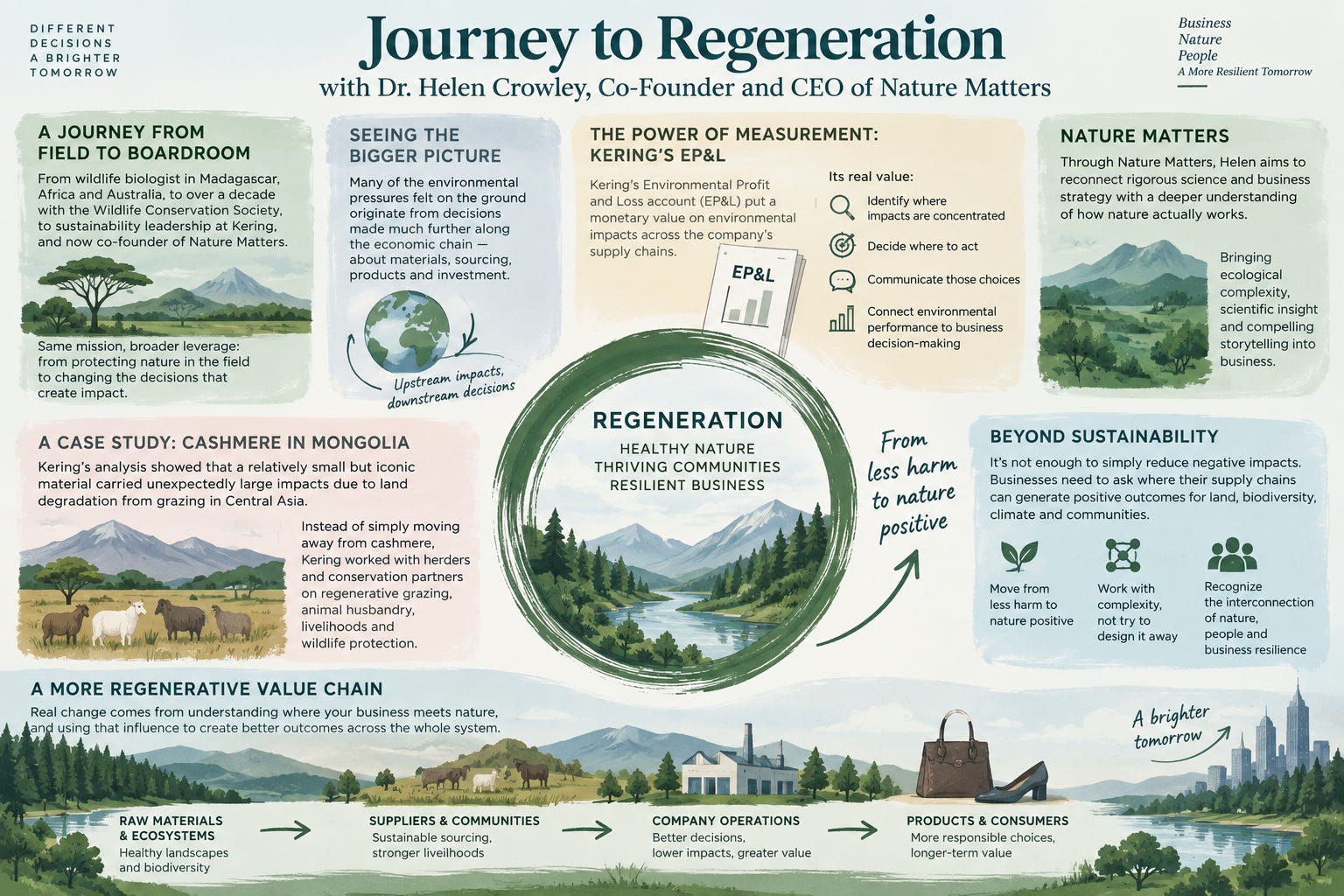
In this episode of Journey to Regeneration, I talk to Dr. Helen Crowley, Co-Founder and CEO of Nature Matters, a conservation biologist whose career has spanned field conservation with the Wildlife Conservation Society, sustainability leadership at Kering, and work advising businesses and investors on nature-positive strategies. Her career trajectory captures an important shift in how we think about regeneration. Protecting ecosystems after damage occurs is essential, but many of the forces determining what happens to those ecosystems originate elsewhere—in corporate choices about sourcing, materials, investment, and supply chains. For Helen, that means businesses need to understand not only their environmental footprints, but where they have the capacity to alter the underlying drivers of nature loss.
Our conversation explores what that looks like in practice. At Kering, the Environmental Profit and Loss account helped reveal impacts that conventional business metrics could easily miss, including the disproportionate environmental costs associated with cashmere production in Central Asia. The response was not simply to substitute the material, but to work with herders and conservation partners in Mongolia on regenerative grazing, livelihoods, animal husbandry, and wildlife protection. That example opens onto a larger argument running through the episode: regeneration requires moving beyond “less bad” toward positive ecological and social outcomes. Helen also explains why biodiversity should not become another silo alongside climate, water, or soil; why businesses pursuing nature-positive outcomes may need to work beyond their immediate operational boundaries; and why measurement, while indispensable, cannot replace an understanding of ecological complexity. For listeners trying to navigate the expanding world of nature targets, disclosure frameworks, and regenerative business strategies, the episode offers a useful reframing: start by finding where your business meets nature, understand the system behind that connection, and determine where intervention can create durable value for ecosystems, communities, and the business itself.
Key Takeaways
Environmental Impact Often Begins Far From Corporate Headquarters
Business decisions about products, materials, sourcing, and purchasing can create ecological consequences deep within supply chains. Understanding regeneration therefore requires companies to trace their decisions back to the landscapes and communities where impacts actually occur.Measurement Matters Most When It Changes Decisions
Kering’s Environmental Profit and Loss account did more than quantify environmental impacts. It helped identify priorities, communicate them internally and externally, and determine where interventions could produce the greatest improvement.Regeneration Is Different From Avoidance
A lower-impact strategy might simply replace a problematic natural material. A regenerative strategy first asks whether the system producing that material can instead be improved to create positive outcomes for landscapes, biodiversity, climate, and livelihoods.Natural Materials Create Both Responsibility and Opportunity
Agricultural and animal-based materials connect companies directly to living systems. That creates environmental exposure, but also opportunities to restore soil, biodiversity, water cycles, livelihoods, and climate resilience through better production practices.Luxury Has Resources to Experiment—but Responsibility Is Not Limited to Luxury
Luxury brands can use their margins, influence, and cultural visibility to pioneer new approaches. But Crowley argues that mainstream companies cannot use lower margins as a reason to abandon responsibility; they instead need to prioritize and innovate differently.Biodiversity Should Not Become Another Sustainability Silo
Soil health, water systems, climate resilience, species diversity, and livelihoods are interconnected. Treating them as entirely separate issues can obscure the ecological processes through which regenerative interventions generate multiple benefits.
Helen Crowley on Moving Business From Less Harm to Nature Positive

In this episode of Journey to Regeneration, Christopher Marquis speaks with Dr. Helen Crowley, Co-Founder and CEO of Nature Matters, a conservation biologist whose career has taken her from field-based biodiversity work with the Wildlife Conservation Society to corporate sustainability leadership at Kering and, more recently, nature-focused advisory and…
Want more conversations like this? Subscribe to Journey to Regeneration on your favorite podcast platform and share this post with someone who cares about the future of business.

The regenerative business practices and sustainability innovations highlighted in this week’s Regenerative Insights directly tackle the critical issues of corporate responsibility explored in my recent book explored in my recent book, The Profiteers: How Business Privatizes Profit and Socializes Cost.
This is a genuinely refreshing shift in framing, and the Kering cashmere example is the strongest evidence for it in the whole piece. The instinct to substitute a problematic material is almost always the easy, defensible move, swap cashmere for something synthetic, tick a box, issue a press release. What Crowley describes instead, staying with Mongolian herders and investing in regenerative grazing rather than walking away from the material entirely, is harder, slower, and far more likely to actually fix something rather than just relocate the harm to wherever the substitute gets made.
Love this approach! If only more companies had the patience for "can I do better here" instead of the much cheaper "how do I avoid." Avoidance usually just exports the problem to a supplier with less power to say no, which is precisely the mechanism Marquis's own book on privatized profit and socialized cost is built around. The real test of whether nature-positive thinking is spreading beyond luxury brands with margin to spare will be whether a mainstream, lower-margin company ever chooses the Kering path when the easy substitute is sitting right there and cheaper.
The choice of terms is far more than mere semantics—language shapes mental models, investment frameworks, and system design.
When we transition from "less harm" or "sustainability" to "nature-positive" and true "regeneration," we shift from minimizing damage to actively expanding ecological and community capacity.
At Project Weaselskin, after 30 years of advancing conservation, agricultural practice shifts, and community connection on the land, we practice what we preach. In the early days, getting others to appreciate whole-systems thinking and circular economic practices was difficult, but times are changing and the investment world needs to catch up to this way of thinking. As the linguist S. I. Hayakawa famously observed, "Words do not mean; people mean"—and in building a regenerative economy, our terms must reflect an intentional commitment to restoring living systems.