

“What I’ve always wanted to be able to do was do good and pay the rent.”
— John Salzinger, entrepreneur and inventor behind Haven
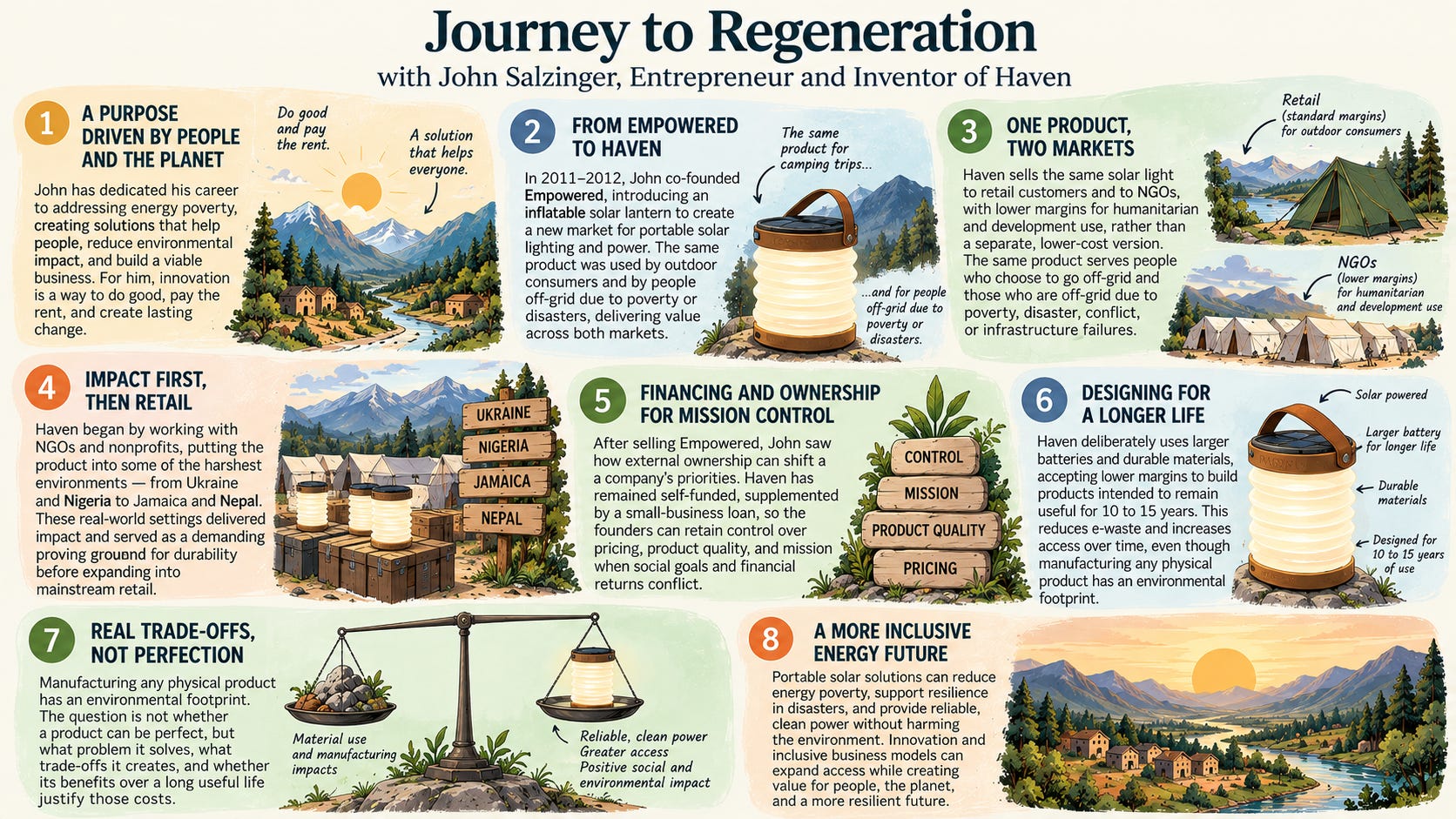
In this episode of Journey to Regeneration, I talk to John Salzinger, an entrepreneur and inventor behind portable solar lighting company Haven who has spent much of his career developing technologies aimed at expanding access to clean electricity. At the heart of his approach is an unusual premise: people buying a solar lantern for camping and people receiving one through humanitarian organizations should not be divided into premium and inferior product markets. Haven instead uses the same product across both, with retail margins creating room to sell to NGOs at reduced margins. With Haven, John and his business partner reversed the conventional sequence of social enterprise by going first to NGOs and nonprofits, putting the product into demanding settings around the world before using that record to build its retail presence.
Our conversation explores why regenerative business depends on more than the environmental attributes of a product. We discuss how financing and ownership affect whether a company’s mission survives growth and acquisition; why John chose to self-fund Haven and use a small-business loan rather than pursue rapid equity-backed expansion; and how lower margins can support better product specifications and broader access. We also examine the unavoidable environmental trade-offs of manufacturing solar technology. Haven uses a large battery and durable materials and is designed for a useful life of roughly 10 to 15 years, an approach intended to reduce replacement and e-waste rather than optimize for short-term margins. For entrepreneurs, the broader lesson is that impact can be designed into the architecture of a company: who owns it, how products are priced, which customers are served first, how long products are expected to last, and how much profit the company needs to extract from each sale.
Key Takeaways
Impact Can Be the Business Model, Not an Add-On
Haven links commercial sales directly to energy access by using healthy retail margins to make the same product available to NGOs at reduced margins.The Same Product Can Serve Very Different Markets
Rather than creating a cheaper humanitarian version, Salzinger argues for providing the same solar technology to people who choose to go off-grid and those who are off-grid by circumstance.Impact Markets Can Be a Product’s Toughest Proving Ground
Haven went to NGOs and nonprofits before retail, deploying its lights in demanding environments including Jamaica, Ukraine, Nigeria, Ethiopia, Nepal, and other locations.Entrepreneurs Have More Financing Choices Than Venture Capital
Haven was self-funded by Salzinger and Sunga Jung alongside a small-business loan, allowing them to retain decision-making authority rather than optimize for a rapid exit.Durability Is an Environmental Strategy
Rather than designing around frequent replacement, Haven aims for a product life of roughly 10 to 15 years, reducing the waste associated with short-lived electronic products.Design and Aesthetics Matter for Impact
Haven treats appearance and usability as more than retail considerations: if people value a product, Salzinger argues, they are more likely to keep, use, and rely on it.
Building for Impact: John Salzinger on Haven, Energy Access, and Mission Control

In this episode of Journey to Regeneration, Christopher Marquis speaks with John Salzinger, entrepreneur and inventor behind portable solar lighting company Haven, about building a commercially viable solar business around the challenge of energy poverty. Salzinger explains a distinctive model in which the same product sold to mainstream retail customer…
Want more conversations like this? Subscribe to Journey to Regeneration on your favorite podcast platform and share this post with someone who cares about the future of business.

The regenerative business practices and sustainability innovations highlighted in this week’s Regenerative Insights directly tackle the critical issues of corporate responsibility explored in my recent book explored in my recent book, The Profiteers: How Business Privatizes Profit and Socializes Cost.