

“It’s never a one size fits all.”
— Heather K. Terry, CEO, GoodSAM
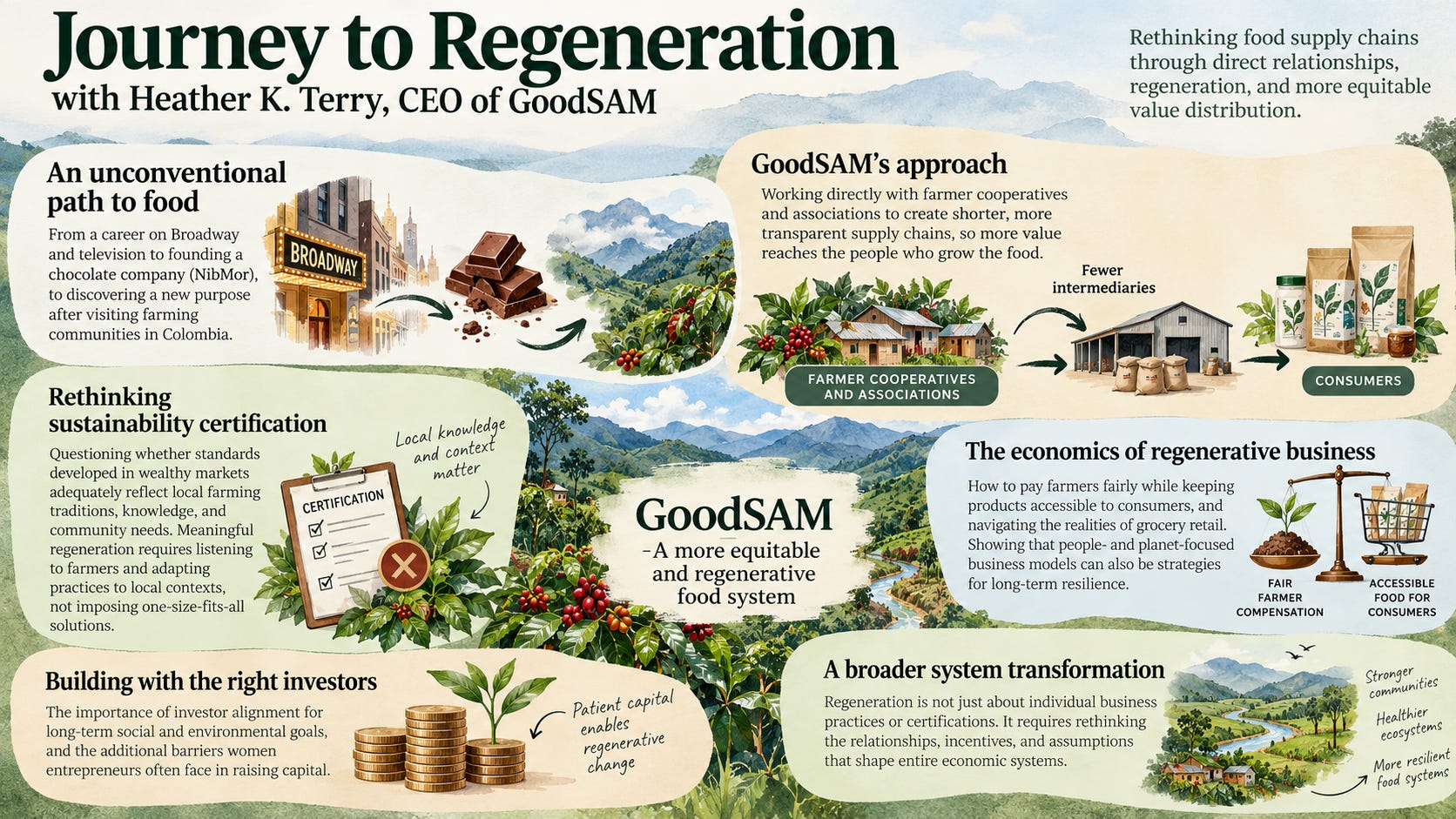
In this episode of Journey to Regeneration, I talk to Heather K. Terry, CEO of GoodSAM, a food company rethinking global supply chains through regenerative agriculture, direct trade, and farmer-centered partnerships. Heather’s unconventional career took her from Broadway and television acting to founding the chocolate company NibMor, before a visit to remote farming communities in Colombia transformed her understanding of how food businesses operate. That experience helped shape GoodSAM’s approach to sourcing directly from farmer cooperatives and associations, reducing dependence on intermediaries while allowing more value to remain with producers. Our conversation explores why genuinely regenerative business models must go beyond certifications and environmental commitments to address deeper questions of economic power, cultural autonomy, and who gets to define responsible production. Heather challenges the assumption that sustainability standards developed in wealthy consumer markets can be universally applied, arguing instead for approaches that recognize local knowledge, traditional farming practices, and community governance.
We also examine the financial and structural tensions that make this approach difficult to scale. Heather explains how GoodSAM balances fair compensation for farmers with the pressures of grocery retail and consumer affordability, and why investing in long-term supplier relationships can strengthen business resilience amid climate disruptions and market volatility. Drawing on her experience raising capital, she offers a candid assessment of the competing priorities of founders and investors, as well as the persistent inequalities facing women entrepreneurs. What emerges is a broader argument about regeneration as systems change: transforming food production requires not only better agricultural practices, but also different incentives, governance arrangements, and expectations of business success. For entrepreneurs, investors, and consumers, Heather’s experience offers an opportunity to reconsider how commercial viability, social equity, and environmental restoration can reinforce one another—and why building a regenerative economy requires both immediate practical decisions and a much longer-term perspective.
Key Takeaways
1. Regeneration Requires Rethinking the Entire Food Supply Chain
Regenerative business goes beyond improving agricultural practices to reconsider how food is sourced, priced, and distributed. GoodSAM demonstrates how changing relationships between farmers, brands, and buyers can create opportunities for more equitable value distribution and stronger supply chains.
2. Direct Trade Can Deliver More Value to Farmers
Reducing reliance on brokers and intermediaries can allow companies to direct more of their purchasing expenditure toward producers. GoodSAM works primarily with farmer cooperatives and associations, demonstrating how collective organizations can make direct sourcing more practical and commercially viable.
3. Farmer-Led Regeneration Must Respect Local Knowledge and Governance
Sustainable sourcing cannot rely on a universal model imposed across different regions. Farming communities have distinct cultural practices, political structures, and agricultural traditions. Effective regenerative partnerships require listening to local stakeholders and adapting commercial relationships to their circumstances.
4. Sustainability Certifications Are Useful but Not Sufficient
Third-party certifications provide consumers with valuable assurances about environmental and ethical standards, but they can also create costs and administrative burdens for producers. Terry questions whether certification systems adequately represent farmers’ interests, emphasizing the importance of meaningful farmer participation in developing standards.
5. Fair Farmer Compensation Strengthens Supply Chain Resilience
Paying farmers fairly is not merely a social responsibility; it can also support long-term business continuity. Terry argues that extractive sourcing practices undermine supplier loyalty, leaving companies more vulnerable to climate shocks, market disruptions, and supply shortages. Trust and reciprocity can become strategic assets.
6. Regenerative Food Faces a Fundamental Affordability Challenge
Products with stronger environmental and social standards often carry higher consumer prices, limiting their accessibility. GoodSAM illustrates the challenge of balancing fair producer compensation with competitive retail pricing. Greater scale, access to financing, and more predictable purchasing commitments could help make regenerative products accessible to more consumers.
8. Regeneration Is a Long-Term Systems Transformation, Not a Fixed Destination
Transforming established economic systems requires patience, adaptability, and a willingness to work through uncertainty. Success should therefore be measured not only by achieving an ultimate vision, but also by making meaningful progress toward more reciprocal relationships between businesses, communities, and nature.
Rethinking Food Supply Chains: Heather K. Terry on GoodSAM's Regenerative Business Model

In this episode of Journey to Regeneration, Christopher Marquis speaks with Heather K. Terry, CEO of GoodSAM, a food company seeking to transform global supply chains through direct trade, regenerative agriculture, and more equitable partnerships with farmers. Drawing on her unconventional journey from Broadway actor to food entrepreneur, Terry explains…
Want more conversations like this? Subscribe to Journey to Regeneration on your favorite podcast platform and share this post with someone who cares about the future of business.

The regenerative business practices and sustainability innovations highlighted in this week’s Regenerative Insights directly tackle the critical issues of corporate responsibility explored in my recent book explored in my recent book, The Profiteers: How Business Privatizes Profit and Socializes Cost.
I find it very useful to shift from talking about "production (food) chains" to "production systems". The systems perspective emphasizes the relational, co-creative, and collective accountability with shared power aspects of regeneration. In a "chain" there is someone at the ends...usually the one closest to the consumer has disproportionate power and the one at the other end has least. And the "links" aspect of "chains" suggests lack of real connection and understanding of the participants in their roles and how best to work together collectively.
I've been experimenting with buying fruit through CrowdFarming, and a lot of this sounds familiar. Growers selling direct, more of the money staying on the farm, and you know whose trees it came from. It's a marketplace rather than a brand, but the principle feels the same.
And the avocados and mangoes are mighty fine - a rare thing this far North.